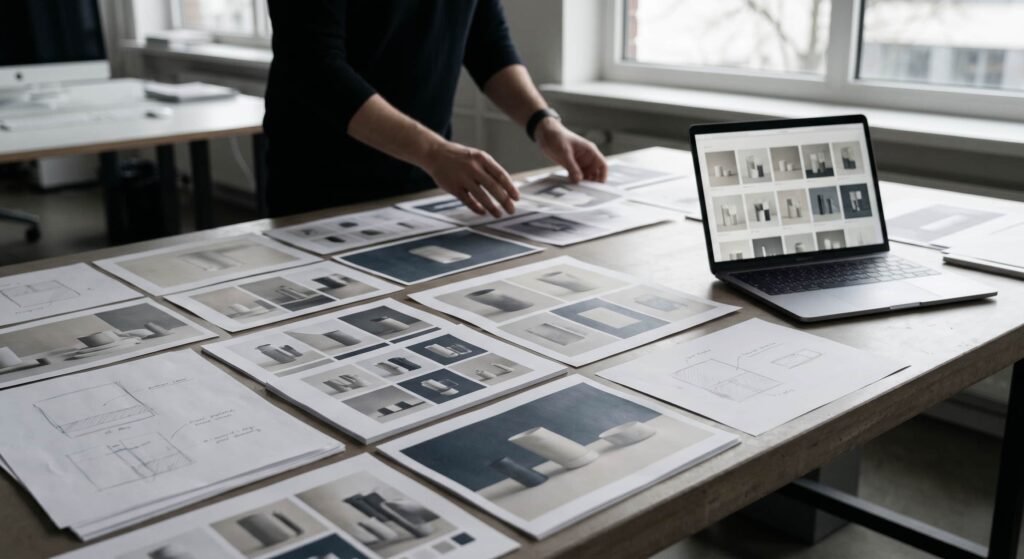
Most discussions around AI product photography focus on outputs.
People evaluate results: Does the image look realistic? Does it match the brand? Could it replace a traditional shoot?
But in practice, success or failure is decided much earlier (long before the image is generated). What most teams treat as a generation problem is almost always a workflow and system design problem. And that distinction changes everything.
Output Obsession
When companies experiment with AI photography, they typically start the same way: open a tool, write a prompt, iterate until something looks good.
At first, this feels productive. The system generates images quickly, and some outputs appear usable.
But patterns emerge fast:
- Inconsistent visual style across assets
- Environments that feel generic or unanchored
- Subtle product distortions
- A visual language that belongs to no brand in particular
The natural conclusion is that AI is not ready yet. The model is rarely the problem. What is missing is a controlled production workflow.
AI Photography Is Not Prompting
The biggest misconception in this space is reducing AI photography to prompt writing.
Prompts are one layer of the system, and not the most critical one.
In a brand environment, a functioning AI photography workflow behaves much closer to a production pipeline than to a creative tool. A controlled system includes:
- Reference inputs: product, composition, lighting, materials
- Visual constraints: brand language, tonal range, realism thresholds
- Iteration logic: what changes between outputs, what stays fixed
- Validation criteria: what makes an image operationally usable
Without these elements in place before generation begins, outputs will always drift. And when outputs drift, teams lose confidence in the system (and not in the process that produced it).
The Real Failure Point: Undefined Inputs
Most failed AI photography experiments share the same root cause: inputs that are too vague to produce controlled results.
Common examples:
- «A lifestyle image of a skincare product in nature«
- «A modern living room with a sofa«
- «A model wearing sunglasses in an urban setting«
These are not wrong prompts. They are simply not specific enough to anchor the system.
No traditional shoot would start with this level of ambiguity. There would be references, art direction, defined lighting, set design, brand guidelines reviewed in pre-production. AI photography requires the same level of precision but translated into a different system.


Reference-Based Workflows: The Layer Most Teams Skip
The most reliable AI photography workflows are built around reference-based generation.
Instead of describing an idea, you anchor the system with exact inputs: SKU-level product references, composition references for environment and framing, defined material and lighting cues, and the visual patterns specific to the brand.
Take a fragrance brand as a concrete example. A reference-based workflow would define the bottle angle, surface material, ambient light temperature, and background register before a single prompt is written. The generation step then becomes a controlled execution, not an open exploration.
That shift changes the nature of the output entirely:
From generative, exploratory, inconsistent → To controlled, repeatable, production-ready
This is the point where AI stops behaving like a tool and starts functioning as infrastructure. The workflow is what makes that transition possible.
Why «Good Looking» Is Not the Right Benchmark
A persistent trap in evaluating AI photography is judging images purely on aesthetics. An image may look convincing at first glance and still fail operationally:
- The product is slightly deformed at the edges
- Material behavior is inconsistent with the real SKU
- Lighting shifts between assets in a way that breaks campaign coherence
- The environment reads as generic rather than belonging to the brand
These issues compound on a scale. What holds for one image breaks when producing twenty, fifty, or two hundred. And at that volume, inconsistency is not a visual problem, it is a production and brand risk.


AI Photography as a Production System
When implemented correctly, an AI photography workflow operates like any disciplined production system:
- Inputs are controlled before generation begins
- Variables are deliberately defined, not left open
- Outputs are predictable within a known range
- Iteration is structured around validation criteria, not aesthetic preference
This is fundamentally different from experimentation. And it is the only model that makes AI viable for e-commerce, paid media, content systems, and campaign extensions.
Without this structure, AI remains a demo. With it, it becomes operational.
What This Means for Brands
For brands evaluating AI photography, the key question is usually framed around image quality.
That is not the right question.
The more relevant question is: Can we control the workflow well enough to trust its output on a scale?
That shift changes how adoption should happen: less focus on tools, more focus on process design; less open-ended experimentation, more defined production logic.
The brands that understand this early will not just produce better images. They will build a visual content system that compounds, one where every asset produced strengthens the brand rather than diluting it.


The Output Is the Last Step
AI product photography does not fail because of image quality.
It fails because most implementations skip the hard part: defining the system that sits behind the image.
The output is only the visible layer. Real work happens before generation begins, in how inputs are structured, how constraints are defined, and how consistency is enforced across an entire workflow. In that sense, AI photography is not a creative shortcut.
It is a production discipline.
